

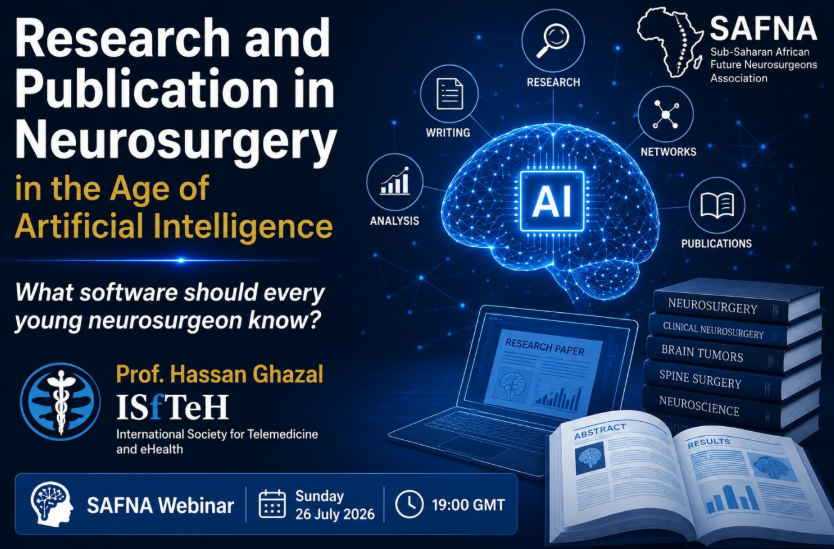
Watch the full video presentation:https://youtu.be/_III7ZricKg
Neurosurgery is a discipline in which excellence traditionally relies on three fundamental pillars: technical expertise, scientific knowledge, and the ability to make complex decisions in often critical clinical situations. Today, a fourth element is increasingly shaping the specialty: Artificial Intelligence (AI).
Beyond its applications in the operating room and medical imaging, artificial intelligence is progressively transforming the way neurosurgeons design research projects, analyze clinical data, interpret findings, and disseminate scientific knowledge.
This technological evolution offers significant opportunities, particularly for young neurosurgeons and research teams working in resource-limited settings.
The question is no longer whether artificial intelligence will become part of neurosurgical research, but rather how professionals can integrate it effectively while preserving scientific rigor and integrity.
1. Artificial Intelligence: A New Approach to Neurosurgical Research
Neurosurgical research is particularly challenging. Studies frequently involve relatively small patient cohorts, heterogeneous pathologies, complex clinical data, and postoperative follow-up that can be difficult to standardize.
In this context, artificial intelligence represents a major opportunity.
Generative AI tools can support researchers throughout several stages of the scientific process:
- Literature review: Identifying relevant publications, exploring emerging research topics, and organizing existing scientific knowledge.
- Research protocol development: Formulating research questions, defining study objectives, and improving methodological design.
- Data analysis: Assisting with database cleaning, statistical programming, and interpretation of results.
- Scientific writing: Improving manuscript structure, language, clarity, and overall readability.
- Scientific publishing: Adapting manuscripts to journal requirements and preparing responses to peer reviewers.
These tools can reduce some of the technical and organizational barriers that traditionally slow down scientific research.
2. From Literature Review to Scientific Publication
One of the major challenges facing young researchers is mastering the scientific publication process.
From developing a relevant research question to conducting a literature search, selecting studies, extracting data, performing statistical analyses, and writing a manuscript, each stage requires specific skills.
Artificial intelligence can make this process more accessible.
Specialized tools can improve literature searches, organize bibliographic references, explore relationships between publications, and facilitate evidence synthesis.
In neurosurgery, these applications may be particularly useful for systematic reviews, meta-analyses, and retrospective clinical studies.
However, an essential distinction must be maintained: facilitating manuscript production does not automatically translate into high-quality scientific research.
The quality of a scientific publication ultimately depends on the relevance of its research question, the robustness of its methodology, the reliability of its data, and the validity of its conclusions.
3. Statistical Analysis: Democratizing Access to Research
Statistical analysis remains a major obstacle for clinicians seeking to develop their research activities.
Mastering statistical software, selecting appropriate tests, understanding multivariable models, and interpreting results require specialized training.
AI can now assist researchers in these different stages by generating analytical scripts, explaining statistical outputs, and facilitating data visualization.
For young neurosurgeons, this represents an opportunity to develop research projects that might previously have required extensive technical support.
Nevertheless, these tools must always be used with methodological supervision and critical judgment. An AI-generated statistical result is not necessarily correct, and a technically successful analysis does not guarantee scientific validity.
Researchers must remain responsible for their data, statistical decisions, and clinical interpretation.
4. Specific Applications Across Neurosurgical Subspecialties
The potential applications of artificial intelligence are particularly promising across several areas of neurosurgery.
Neuro-oncology
AI can contribute to the analysis of radiological and histopathological features of brain tumors, tumor segmentation, and the identification of prognostic factors.
Neurovascular Surgery
Machine learning algorithms can help investigate factors associated with arteriovenous malformation rupture, analyze angioarchitectural characteristics, and develop predictive models.
Spine Surgery
Automated analysis of radiological parameters, assessment of sagittal balance, and prediction of postoperative complications represent promising research directions.
Functional Neurosurgery
AI offers opportunities in electrophysiological data analysis, deep brain stimulation, treatment planning, and the evaluation of functional outcomes.
Stereotactic Radiosurgery
The analysis of treatment-planning data, tumor response assessment, and identification of predictive factors are particularly interesting areas for future research.
5. Challenges and Limitations: Preserving Scientific Integrity
Integrating artificial intelligence into scientific research is not without risks.
The generation of fabricated bibliographic references, interpretation errors, algorithmic bias, and unsupported conclusions represent significant threats.
The use of medical data also raises important concerns. Personally identifiable patient information should never be entered into unsecured or unauthorized platforms.
Furthermore, researchers must comply with journal policies, disclose AI assistance when required, and respect established principles of scientific authorship and accountability.
Artificial intelligence cannot be considered an independent scientific author. Human researchers remain responsible for the accuracy of information, methodological decisions, and the final content of their publications.
The objective is therefore not to replace scientific reasoning, but to enhance it.
6. A Strategic Opportunity for Young African Neurosurgeons
One of the most important dimensions of this transformation concerns low- and middle-income countries.
Across several African countries, young neurosurgeons face considerable challenges in accessing research infrastructure, statistical expertise, scientific literature, and international research collaborations.
Artificial intelligence could help reduce some of these inequalities.
It offers opportunities to make better use of existing hospital data, establish neurosurgical registries, develop multicenter collaborations, and facilitate the production of high-quality scientific publications.
However, sustainable progress will require investment in methodological training, data protection, and appropriate digital infrastructure.
Africa should not simply become a consumer of technologies developed elsewhere. It must also contribute to their design, development, and validation by generating scientific evidence that reflects the realities and needs of its own populations.
Young African neurosurgeons therefore have a particular responsibility: to become not only users of these technologies but also active contributors to scientific innovation.
Conclusion: The Neurosurgeon of Tomorrow Will Also Be an AI-Augmented Researcher
Artificial intelligence represents a major development in the history of medical research. In neurosurgery, it offers new opportunities to accelerate scientific production, improve clinical data utilization, and facilitate knowledge dissemination.
However, technology will never replace the foundations of scientific research: curiosity, critical thinking, methodological rigor, and intellectual responsibility.
The real challenge for the next generation of neurosurgeons will be to learn how to work alongside these tools without becoming dependent on them.
The neurosurgeon of tomorrow will not simply be the one who masters new technologies in the operating room. They will also be the one who can transform clinical data into scientific knowledge, knowledge into innovation, and innovation into tangible benefits for patients.
In the era of artificial intelligence, our ambition must remain unchanged: advancing neurosurgery in the service of humanity.
Watch the Full Presentation
For a deeper understanding of the topic and its practical implications, watch the full presentation here:https://youtu.be/_III7ZricKg
Originally shared via YouTube.